





Halloween with a Finnish Lapphund: candy, costumes, doorbells and Kekri
The doorbell is the whole problem. A Finnish Lapphund spends eleven months of the year learning t...

Timber follows me from room to room. He supervises the dishwasher, the laundry, and every walk to the end of the driveway here in Castlegar. So the question I hear most from people looking at this breed is a fair one. Can a Finnish Lapphund be left alone while you go to work?

A healthy adult Lappy can be left alone. The breed just has a lower tolerance for it than many others, and that is by design. The Finnish Lapphund Club of America says it in one line. "The Finnish Lapphund needs to be a part of your family, they are a breed of 'pack' nature and their family is their 'pack'." The American Kennel Club calls the breed remarkably empathetic and among the friendliest of all dogs. Friendly dogs like company.
Herding heritage adds a second layer. These dogs were bred to work alongside people and to talk while they did it. A Lappy left with an empty afternoon and a window onto a busy street will find a job, and the job it picks is usually barking. The same club page makes the link direct. If your Finnish Lapphund is a problem barker, it says, he is probably bored and looking for your attention.
So the honest picture is a middle one. Lappies are not clingy shadows who fall apart at the door, and they are not the dog to pick if the house sits empty from seven to six. Mine sleep through most of a quiet weekday morning. They also meet me at the door like I have returned from a polar expedition. If you want more on how that personality behaves day to day, my Finnish Lapphund temperament guide goes deeper.
Four hours is the number worth planning around. The RSPCA advises that dogs "are left for no longer than four hours so they have opportunities to exercise, go to the toilet, and spend time with people." That is welfare guidance for dogs in general, and it fits this breed well.

Puppies are a different calculation, and the limit is a plumbing one. The AKC's puppy potty training timeline gives a simple rule. Take the age of your puppy in months, add one, and that is the maximum number of hours the puppy should be able to hold it comfortably. A four month old puppy gets five hours at the outside, and that is a bladder ceiling, not a company ceiling.
| Age or stage | Realistic alone stretch | What to arrange |
|---|---|---|
| 8 to 12 weeks | Under an hour, and only after practice | Someone home nearly all the time; short solo naps in a pen or crate |
| 3 to 5 months | 2 to 4 hours (age in months plus one) | Midday visit; a fixed toilet break before and after |
| 6 to 12 months | 3 to 4 hours | Exercise first, food toy during, a real walk after |
| Adult, settled | About 4 hours as routine | A midday walker or a break for anything longer |
| Senior or unwell | Shorter again | More toilet breaks; vet advice on comfort and cognition |
Notice what the table does not say. It does not say your Lappy will be miserable at four hours and one minute. Dogs vary, and a calm eight year old who has practised being alone since puppyhood may nap happily through a long errand run. The point of the number is planning. If your week needs nine hour solo days as standard, this breed will make its feelings known.
You teach it the way you teach anything else to a thinking dog. In tiny pieces, early, before anything goes wrong. The RSPCA lays out a five stage progression that works well with a Lappy puppy, and the whole trick is never letting the puppy get worried in the first place.
Two extras matter with this breed. First, take the drama out of your departures and returns. VCA Animal Hospitals recommends keeping goodbyes and hellos low key, and identifying the cues that already set the dog off, like picking up keys or putting on a coat. Practise those cues at random times when you are staying put. Pick up the keys, make tea, sit down.
Second, make the crate or the pen a good address. I feed breakfast in there with the door open, using the dog's own stainless bowl, so the space smells like food and quiet rather than like leaving. My Finnish Lapphund puppy guide covers the crate introduction in more detail.

Something. Half the alone-time problems in this breed come down to an empty afternoon. A Finnish Lapphund is a working brain in a fluffy coat, and an empty room is an invitation.
Food is the easiest lever. VCA's guidance on enrichment and activity toys explains why. Foraging toys "encourage sniffing, chasing, capturing, manipulating, seeking, licking, chewing, and crunching, which are all enjoyable behaviors for dogs and cats", and providing an outlet for that oral behaviour can lower the frequency of nuisance behaviours. Practically, that means the morning meal leaves the bowl and goes into work.
Exercise before you leave is the other half. A walk and five minutes of training beats any gadget, because a Lappy that has used its nose and its head settles. My Finnish Lapphund exercise guide has the daily amounts by age, and the barking guide deals with the neighbours question directly.
These get treated as the same problem and they are not. Boredom is a dog with nothing to do. Separation distress is a dog in a panic. The fix for one is a job. The fix for the other is a slow behaviour plan and often a vet.
The ASPCA's separation anxiety page is useful here because it lists what to rule out first. Incomplete house training. Submissive or excitement urination. Urine marking. Juvenile destruction, which happens whether you are home or not. And boredom, where, in the ASPCA's words, "these dogs usually don't appear anxious."
| What you see | Looks like boredom | Looks like separation distress |
|---|---|---|
| Timing | Scattered through the absence, often later on | Starts within minutes of the door closing |
| Happens when you are home too? | Often yes | Almost never |
| Body language on camera | Relaxed, busy, then asleep | Pacing a fixed path, panting, drooling, ears back |
| Damage | Anything chewable, anywhere | Doors, window frames, the crate, the exit points |
| Toileting | Random, or a training gap | Soon after you leave, in a house-trained dog |
| Food | Eats the stuffed toy straight away | Will not touch food until you are back |
Get a camera on it before you decide. A cheap phone propped on a shelf is enough. VCA notes that the emotional picture varies too, because some dogs showing distress are more frustrated than anxious and some are simply restless. Video tells you which dog you have, and it gives your vet something better than a guess.
One number worth knowing, from home ground. Salonen and colleagues surveyed 13,700 Finnish pet dogs for the paper Prevalence, comorbidity, and breed differences in canine anxiety, published in Scientific Reports in 2020. Noise sensitivity came in at 32 percent of dogs and fear at 29 percent. Separation related behaviour was the least common anxiety trait they measured. So the loud, destructive afternoon you are picturing is real, and it is far less common than plain unspent energy.

This is general information, not veterinary advice. Book the appointment when any of the following show up.
Your own vet comes first, because the medical rule-outs are theirs. From there, a referral to a board-certified veterinary behaviourist is the strongest option, and a certified behaviour consultant is the practical one for most of us. You can search the IAABC consultant directory or the CCPDT certified trainer and behaviour consultant directory, both of which cover Canada and the US and list virtual options. Look for reward-based methods. A sensitive Finnish Lapphund handled with corrections gets worse, faster.
On medication, I have one line and I am staying in my lane. Anti-anxiety medication exists, the ASPCA says most dogs with true separation anxiety need behaviour work alongside it, and the decision belongs to your veterinarian. Never medicate a dog on advice from a blog, mine included.
Plenty of Lappy owners work full time. They build the day around the dog instead of hoping.
A word on getting a second dog as the cure. It sometimes helps a bored dog and it rarely helps a panicked one, because the attachment is to you. Two Lappies is a wonderful life, and it is a decision to make for its own reasons. Mine came fourteen months apart and Tundra learned half his manners from Timber. That is companionship, not therapy.
Alone time is a skill, and this breed learns skills well. Start it in the first week, keep the sessions short, feed the brain, and watch what happens on camera before you name the problem. Most Finnish Lapphunds settle into a work day just fine once somebody teaches them how.
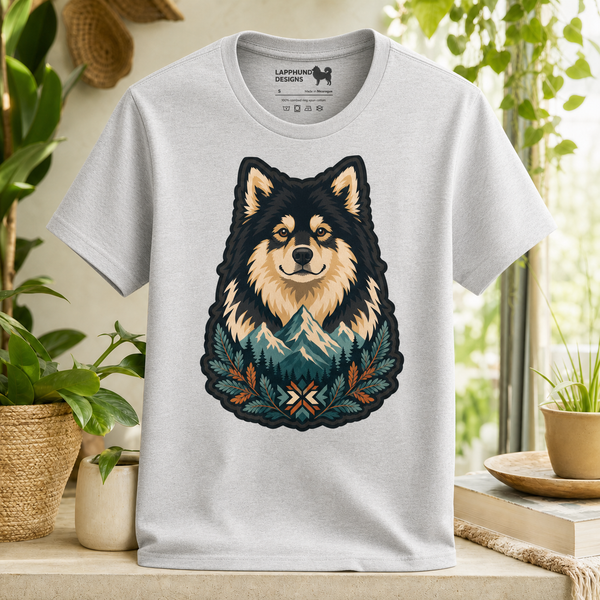
And if you own one of these dogs, you already know the face they make from the window as you back down the driveway. There is a sticker sheet in the shop that is nothing but that face, drawn breed-true, and it is the one Lappy owners send me photos of most. The rest of the Lapphund Designs shop is built the same way, one coat at a time, by people who came home to the same greeting.
No, this is one of the breeds that struggles with it. The Finnish Lapphund Club of America describes the breed as a pack animal whose family is its pack, and a bored Lappy alone all day tends to bark or chew. Around four hours is the sensible planning number for a settled adult, with a walker or a midday break for anything longer.
Very little at first, and the bladder sets the ceiling. The AKC's rule is the puppy's age in months plus one, so a four month old puppy can hold it for about five hours at most. Company is a separate need, so build solo time in seconds and minutes from the first week and never leave a young puppy long enough to panic.
Some do, though it is less common than plain boredom. True separation distress starts within minutes of your departure, happens almost only when you are gone, and shows up as pacing, drooling, escape attempts or damage at exit points. Set up a camera before you decide which one you are looking at.
Deal with the cause rather than the noise. Exercise and a short training game before you go, a frozen food toy for the first half hour, and closed curtains on the street-facing window solve most of it. If the barking starts the second the door closes and continues for hours, treat it as distress and talk to your vet.
Usually not, because the attachment is to you rather than to dogs in general. A second dog can help a bored dog pass the time, and it can also double the problem if the first dog is panicking. Get a second Lappy because you want a second Lappy.
Start with your own veterinarian, who can rule out pain, illness and age-related change. From there, ask for a referral to a board-certified veterinary behaviourist, or search the IAABC and CCPDT directories for a certified behaviour consultant who works with reward-based methods. Any medication decision belongs to your vet.

Written by Jill, co-founder of Lapphund Designs. Jill lives in Castlegar, BC with her husband and their two Finnish Lapphunds, Timber and Tundra.
Every design in the shop starts from the real Finnish Lapphund. See every design Pick your Lappy's coat
Finnish Lapphunds absolutely love snow, many owners report their dogs refusing to come inside during winter.
The doorbell is the whole problem. A Finnish Lapphund spends eleven months of the year learning t...

I have heard our breed called a Lap-a-hound, a Finnish Lap Hound and, once, a Finnish Lampshade. ...

A few times a month somebody sends me a photo of a fluffy dog and asks whether it is part Finnish...
Comments (0)
Leave a comment