




Halloween with a Finnish Lapphund: candy, costumes, doorbells and Kekri
The doorbell is the whole problem. A Finnish Lapphund spends eleven months of the year learning t...

The first time I taught Timber to sit, he had it in about three repetitions, then looked at me like he was waiting for the next question. Finnish Lapphunds are clever, and they learn fast. The catch is that they think for themselves, they bark for a living, and they were bred to chase moving things across the tundra. So training a Lappy is less about drilling commands and more about working with a smart, sensitive partner. Here is how I approach it, owner to owner, with what the breed clubs and vets actually recommend.

Generally yes, with one caveat. The Finnish Lapphund is an AKC Herding Group breed described as intelligent, alert, agile, friendly, and eager to please, and the UK Royal Kennel Club standard lists the temperament as "Intelligent, brave, calm, faithful" (AKC, Finnish Lapphund breed page; Royal Kennel Club, UK). That is a great starting point for any owner.
The caveat is the independent streak. The Lappy is often called a thinking breed that learns quickly and can be a little strong willed, so it does best with training that is short, engaging, consistent, and reward based rather than punitive (AKC, Finnish Lapphund facts). In practice your Lappy is smart enough to ask what is in it for them. Make the answer worth their while and they are wonderful students. If you are still deciding whether this breed fits your life, our is a Finnish Lapphund right for you guide covers the whole picture.
Almost every quirk you will train around traces back to one job, which was herding reindeer in the Arctic. The breed was developed by the Sami people of Lapland from earlier hunter and protector dogs into reindeer herders, and Lapponian type dog remains have been dated to roughly 7000 BC (AKC, Finnish Lapphund history). The first Finnish Kennel Club standard came in 1945, and in 1967 the long coated dogs were given a separate standard as the Finnish Lapphund, split from the short coated Lapponian Herder (Finnish Lapphund Club of America, breed history).
Here is the part that matters for training. Unlike herding breeds that nip at heels, Finnish Lapphunds were bred to move reindeer with their bark, and they remain vocal watchdogs today (AKC history). The Royal Kennel Club standard even notes a "tendency to herd" as a breed characteristic (Royal Kennel Club). So the barking, the chasing, and the independence are the job your dog was bred for, showing up in your living room. The rest of this guide is about giving that instinct a healthy outlet.

Positive reinforcement, full stop. You reward the behaviour you want, and you reward it the instant it happens. Timing is everything, because reinforcement must immediately follow the behaviour or you risk reinforcing the wrong action (VCA Hospitals). A clicker or a simple marker word such as "yes" helps you mark the exact moment, then deliver the treat.
Rewards do not have to be food. Toys, play, a walk, or real praise all work, and the best reward is whatever your individual Lappy loves most (VCA). When you are teaching something new, reward every correct response, which is continuous reinforcement. Once your dog responds reliably, switch to rewarding now and then on a variable schedule, which makes the behaviour more durable (VCA).
Skip the harsh stuff. Yelling and loud corrections raise a dog's arousal and anxiety, which is the opposite of a calm, thinking learner, and they backfire on a sensitive, alert breed like this one (VCA). Breed specific guidance agrees that training should be consistent and gentle, since excessively strict methods are counterproductive for a sensitive Lappy (Southern Finnish Lapphund Society). The wider veterinary position matches. The American Veterinary Society of Animal Behavior's 2021 statement recommends reward based methods only, for all training and behaviour modification (AVSAB position statement).
| Do this | Skip this | Why it works for a Lappy |
|---|---|---|
| Short sessions of 5 to 10 minutes, a few times a day | Long, repetitive drills | A thinking breed gets bored and tunes out |
| Reward the instant the behaviour happens | Delayed treats minutes later | Late rewards mark the wrong action (VCA) |
| High value rewards your dog truly loves | Low value kibble for hard tasks | Independent dogs need a real reason to comply |
| Calm, consistent cues | Yelling or harsh corrections | Loud voices raise anxiety and arousal (VCA) |
| End every session on a win | Grinding on until it falls apart | A sensitive dog remembers how the session felt |
Start with the everyday basics, then add the two cues this breed needs most. The foundation commands work exactly as they do for any dog. Lure or capture the behaviour, mark it, reward it, and build up gradually. Because Lappies learn quickly, you can usually layer in a new behaviour every few days as long as you keep sessions short and fun.
My order of operations looks like this. Name recognition and a marker word come first, then sit and down, then a hand target, then "leave it," then loose leash walking, then stay and settle. The two cues to prioritize alongside those for a Finnish Lapphund are a "quiet" cue, because they are natural barkers, and a rock solid recall, because they love to chase. Both get their own section below. Get those two reliable and daily life with a Lappy gets a great deal easier. A tee in my own shop reads trainable with snacks, which is the most accurate breed description I have ever printed.
They bark because it was literally their job, so plan to train around it rather than be surprised by it. The breed is markedly vocal, a trait carried straight over from using the bark to control the reindeer herd, and it can be trained to limit barking (AKC facts; Southern Finnish Lapphund Society). Set your expectations sensibly. The goal is an off switch, not total silence.
To teach "quiet," wait for a pause in the barking, mark it with your word or clicker, and reward the calm. Over many repetitions your dog learns that quiet pays better than noise. The big mistake to avoid is yelling at a barking dog, because loud voices increase arousal, and giving any attention to barking can accidentally reward it (VCA). Start early, since a "quiet" cue is a core training task for this breed. Our full guide to why Finnish Lapphunds bark and how to manage it goes deeper on triggers and management.
Deliberately, because a tired body with a busy brain still paces. The Finnish Lapphund Club of America describes the breed as having moderate exercise needs and being happy to relax indoors afterwards, and that is the behaviour you want to build rather than assume (FLCA, Living with a Lapphund).
Mat training is the tool I use. Put a mat down, reward your dog for stepping on it, then for lying down on it, then for staying there while you move around the room. Feed the calm in small pieces rather than one exciting treat. Build up to the doorbell ringing while your dog stays put. A settle mat gives an alert breed somewhere to be during dinner, visitors, and the after school chaos.
Crate work fits the same purpose. Feed meals in the crate with the door open, throw treats in for free, and only ever close the door once your dog goes in willingly. A crate that predicts good things becomes a place to nap, which is exactly what an over stimulated Lappy needs at eight months old.

Early, and the window matters. The sensitive socialization period runs roughly from 3 to 16 weeks of age, when safe, positive exposures help inoculate a puppy against developing fearful behaviour (VCA Hospitals). During this stretch, introduce your Lappy puppy to lots of friendly people, gentle dogs, surfaces, sounds, and handling, always keeping it positive and low pressure.
Do not stop at 16 weeks. Continued calm, positive social experiences through adolescence, roughly 6 to 18 months, build lasting confidence (VCA). This matters extra for a Finnish Lapphund, because the breed has a strong startle reflex, a trait that served it when a reindeer suddenly turned, and can be a little reserved about novelty (AKC facts). Talk to your veterinarian about a safe socialization plan and vaccination timing so you balance early exposure with health.
Your beautifully trained puppy forgets his name for a few months. This breed matures slowly, with puppy behaviour running well into the second year, so the wobble lasts longer than owners expect. Recall gets patchy around seven to twelve months. Barking often ramps up. New things that were fine at four months suddenly warrant an opinion.
The answer is management, not escalation. Go back to the long line. Shorten your sessions. Raise the value of your rewards. Keep the social outings calm and short rather than dropping them. Tundra spent one entire autumn pretending she had never heard the word "come," and the only thing that fixed it was six weeks of easy wins on a fifteen metre line.
Recall is the one to take seriously, because the chase and explore drive makes it harder for this breed. Set expectations sensibly, then practise it like a lifelong habit. A detailed breed specific recall guide recommends a clear set of steps:
This is enthusiast and breeder guidance, and it lines up neatly with mainstream positive reinforcement training, especially the rule about rewarding the instant your dog reaches you (VCA). Until recall is reliable, keep your Lappy on leash or in a securely fenced space near roads or wildlife.
You channel it rather than erase it. Lappies retain a herding and chase drive toward fast moving animals such as squirrels, rabbits, and cats, and some will even try to herd the household cat. Because they were bred as herders rather than hunters, this is better described as chase or herding drive than classic prey drive, and the intensity varies a lot from dog to dog.
The management toolkit is simple and leans on the cues above. A securely fenced yard is essential regardless of size, because the herding instinct will send your Lappy after anything that runs (Finnish Lapphund Club of America, Living with a Lapphund). Pair that with leashes in open areas, the reliable recall you are building, and structured chase outlets such as fetch or flirt pole play so the drive has somewhere productive to go. Teach a "leave it" you can use at distance, and practise it on moving things before you need it on a deer.
Reward the position you want before your dog invents one. A Lappy on a walk is reading the whole neighbourhood, so the leash becomes a negotiation unless you pay for attention. Mark and feed every time your dog looks up at you or the leash goes slack, especially in the first two minutes when arousal is highest.
Stop moving when the leash tightens and start again when it loosens, so pulling never pays with forward progress. Use a well fitted harness rather than anything that tightens on the neck, which suits a heavily coated dog and matches the reward based approach. And accept sniffing as part of the deal. A ten minute sniffy walk settles this breed more than a brisk thirty minute march.

The ones that make a thinking dog think. Finnish Lapphunds channel their trainable intelligence into dog sports and working roles, including agility, obedience and rally, tracking, herding trials, therapy work, and search and rescue (AKC facts). The breed needs daily exercise and has an off switch afterwards, with the breed club calling its exercise needs moderate (FLCA, Living with a Lapphund).
If you want to start, the AKC's guide to getting into sports and events suggests going to watch a trial or two first, then getting involved with a local club for training and mentorship (AKC, get started in dog sports). Rally is the gentlest entry point for most owners, scent work suits a nose driven dog with no jumping load, and a herding instinct test asks nothing of your dog beforehand. Our guide to Finnish Lapphund dog sports covers each discipline and what the breed tends to be good at.
The practical payoff is that a Lappy who gets real mental and physical work is far less likely to invent its own jobs, like barking at the window or reorganizing the cat. Mix in puzzle feeders, short training games, and scent work on rainy days. With Timber and Tundra, ten minutes of find it games tires them out more than a long boring walk ever does. The Sports and Athletics sticker sheet came straight out of watching Tundra take a course far more seriously than I did.
Before you ramp up to high impact sports, get your vet involved. This is a working breed with recognized joint and eye conditions, so a fitness and joint readiness check is sensible. The Finnish Lapphund Club of America participates in the OFA CHIC program. Recommended screening includes an OFA hip and elbow evaluation, an ophthalmologist eye exam, and the prcd-PRA DNA test. A CHIC number also requires permanent identification such as a microchip (Finnish Lapphund Club of America, general health).
One caveat the club itself stresses: DNA tests check for specific known mutations only and should never replace routine eye examinations, since some forms of PRA appear only later in life (FLCA, general health). This is general information, not veterinary advice. Always talk to your own veterinarian about health screening and your dog's readiness before starting intensive training or high impact dog sports. Our guide to Finnish Lapphund health problems explains each screening in plain language.
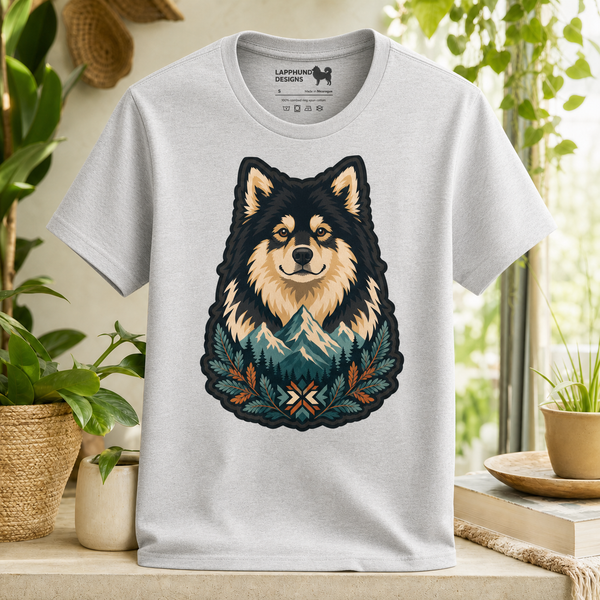
Training a Finnish Lapphund is one of the real joys of living with one. They are clever, funny, and willing to work with you once you make it worth their while. Timber still offers me three behaviours in a row when he wants something, which is cheating and also charming. If you want to celebrate your training partner, everything in my shop is drawn breed true, in every coat, from the Finnish Lapphund t-shirts I wear to class to the stickers that end up on the treat tin.
Generally yes. The Finnish Lapphund is an AKC Herding Group breed described as intelligent, alert, and eager to please, and the Royal Kennel Club calls its temperament intelligent, brave, calm, and faithful. It learns quickly and is a thinking breed with an independent streak, so training works best when it is short, engaging, consistent, and reward based rather than punitive.
Barking is part of their job description. Unlike herding breeds that nip at heels, Finnish Lapphunds were bred to move reindeer with their bark, and they remain vocal watchdogs today. Teaching a "quiet" cue early with positive reinforcement is a core training task, and you should avoid yelling, which raises arousal and can accidentally reward the barking.
Recall is challenging because of the breed's chase and explore drive. Breed specific guidance recommends reserving high value jackpot rewards just for recall. Use a distinct verbal cue plus a whistle or hand signal, start in fenced low distraction areas, and keep a long line on while the behaviour is new. Practise across different locations, release the dog back to its activity after a successful recall, and treat recall as lifelong daily practice.
They retain a herding and chase drive toward fast moving animals such as squirrels, cats, and rabbits, and some will try to herd household cats. Because they were bred as herders rather than hunters, it is better described as chase or herding drive than classic prey drive, and intensity varies by individual. Manage it with secure fencing, leashes, a reliable recall, and structured chase outlets.
Early. The sensitive socialization window is roughly 3 to 16 weeks of age, when safe, positive exposures help inoculate a puppy against fearful behaviour. Keep up positive, calm social experiences through adolescence, about 6 to 18 months, to build lasting confidence, which matters for a breed with a notable startle reflex. Ask your veterinarian about a safe socialization and vaccination plan.
Most do. The breed matures slowly, with puppy behaviour running into the second year, so recall gets patchy and barking often increases somewhere between seven and twelve months. Go back to the long line, shorten sessions, raise your reward value, and keep social outings short and calm. It passes.

Written by Jill, co-founder of Lapphund Designs. Jill lives in Castlegar, BC with her husband and their two Finnish Lapphunds, Timber and Tundra.
Every design in the shop starts from the real Finnish Lapphund. See every design Pick your Lappy's coat
Finnish Lapphunds treat every visitor like a long-lost friend they have been waiting their entire life to meet.
The doorbell is the whole problem. A Finnish Lapphund spends eleven months of the year learning t...

I have heard our breed called a Lap-a-hound, a Finnish Lap Hound and, once, a Finnish Lampshade. ...

A few times a month somebody sends me a photo of a fluffy dog and asks whether it is part Finnish...
Comments (4)
* * * <a href="http://gbfreelancing.com/index.php?u9ujwt">Unlock Free Spins Today</a> * * * hs=2ea72b0a8f86894bba64743f05fa2622* ххх* • August 01, 2025
qq4wtw
* * * Win Free Cash Instantly: http://gbfreelancing.com/index.php?u9ujwt * * * hs=2ea72b0a8f86894bba64743f05fa2622* ххх* • August 01, 2025
qq4wtw
* * * <a href="http://m-emp.com/index.php?ohqaxx">Win Free Cash Instantly</a> * * * hs=2ea72b0a8f86894bba64743f05fa2622* ххх* • June 04, 2025
cdldkv
* * * Snag Your Free Gift: http://m-emp.com/index.php?ohqaxx * * * hs=2ea72b0a8f86894bba64743f05fa2622* ххх* • June 04, 2025
cdldkv
Leave a comment