





Halloween with a Finnish Lapphund: candy, costumes, doorbells and Kekri
The doorbell is the whole problem. A Finnish Lapphund spends eleven months of the year learning t...

The first time I watched a Finnish Lapphund run an agility course, I laughed out loud. He barked at the tunnel, barked through the weaves, and finished clean with his tail over his back like he had invented the sport. That is the breed in one run. A Lappy will work all day for you, and it will have opinions about the work.

Almost all of them, within reason. The Finnish Lapphund Club of America lists the breed's range in a single line. It runs from "obedience to agility, rally, CGC (Canine Good Citizen) and therapy dogs to tracking and even search and rescue." The Finnish Lapphund Club of Canada keeps a performance page covering conformation, traditional obedience, rally obedience, scent detection and agility.
The build explains a lot of it. This is a smaller than medium spitz, with males around 49 cm (19.5 in) at the shoulder and females around 44 cm (17.5 in), and adults commonly 15 to 24 kg (33 to 53 lb). The FLCA describes working Lapphunds as very agile and capable of sudden bursts of speed. So you get a dog light enough to turn tight, strong enough to jump a mid-height bar, and built for cold weather rather than for a July trial.
The mind explains the rest. Lappies were bred to herd reindeer by voice and by position, which means thinking at a distance and taking direction at the same time. That combination is exactly what sport asks for. It also means a bored Lappy invents its own curriculum, which is why my Finnish Lapphund exercise guide puts brain work on the same footing as walks.
| Sport | What it asks of the dog | Fit for a Lappy | Earliest realistic start |
|---|---|---|---|
| Agility | Speed, turns, obstacles, handling at distance | Strong. Agile frame, loves the game, often vocal about it | Foundation from 4 months, full jumps after growth plates close |
| Rally | Heelwork through a course of signs, handler may talk | Excellent. Chatty handling suits a chatty breed | 6 months for AKC rally |
| Obedience | Precision heeling, stays, recalls, retrieves | Good, with short upbeat sessions | 6 months |
| Herding tests and trials | Moving stock with control and confidence | Very good instinct, style is vocal and close | Instinct test at 6 months, AKC herding tests at 9 months |
| Nosework and scent detection | Finding target odour in containers, rooms and outdoors | Excellent, and the easiest entry point of all | 6 months for AKC Scent Work |
| Tracking | Following a scent trail across ground over distance | Strong, and it suits a cold-weather coat | Puppy foundation, tests as an adult |
| Trick titles | Learned behaviours performed on cue | Excellent. Low impact and puppy friendly | Titles awarded from 4 months |
| Therapy visiting | Calm, friendly, unbothered by strangers and equipment | Excellent, given the breed's temperament | Adult, after certification |
Fast enough to be competitive, and rarely the fastest dog in the class. A well-conditioned Lappy runs a clean course with tight turns and good contacts. Border Collies still win the speed classes. Most Lappy handlers I know are chasing clean runs and titles, and they get them.

Two practical notes. The breed jumps in a middle height division because of its size, which is kinder on the body than the tallest classes. And Lappies often bark while they run. Judges do not fault noise, so long as the dog is working, and the handler learns to raise their voice over their own dog.
The age rules differ by country and they matter. AKC agility requires dogs to be fifteen months of age or older, per the Regulations for Agility Trials. In Canada, the CKC agility rules are stricter. Rule 6.1.3 says a dog "must be at least 18 months of age to participate in approved trials, 12 months of age for sanctioned matches." You can see the current rulebook from the CKC agility page.
Foundation work fills the wait. Flatwork, body awareness, tunnels, low planks, targeting and rear-end awareness all happen at ground level. By the time the bars go up, the dog already knows the job.
Rally is where I send every new Lappy owner first. You and your dog walk a course of ten to twenty signs, performing the exercise each sign asks for. AKC Rally runs from Novice through Master and requires the dog to be at least 6 months of age. The Finnish Lapphund Club of Canada calls rally "an excellent introduction to all CKC companion performance events", and I agree with them.
What makes rally kind to this breed is the talking. You can encourage your dog through the whole course. A sensitive Lappy that would wilt under silent formal obedience blooms when its person keeps up a running commentary.
In Canada there are two routes. The Canadian Kennel Club runs rally obedience trials for registered dogs. CARO, the Canadian Association of Rally Obedience, has run titling trials since 2002 and does not require membership to compete, which makes it an easy first trial.
Formal obedience takes longer and pays well. Heeling, stays, recalls and retrieves reward the precision a Lappy can offer once it trusts you. Keep sessions short and end early. My Finnish Lapphund training guide covers the reward-based method this breed needs, and the temperament guide explains why corrections backfire.

Often, yes, and the style surprises people. Reindeer are not sheep. They are large, they are not much afraid of dogs, and the Sami dogs that moved them worked with voice and body position from a respectful distance. So a Lappy on stock tends to be loud, upright and busy. It is real herding, done in the breed's own accent.
The AKC runs three non-competitive levels before you ever enter a trial, in a fenced arena with ducks, sheep or cattle. As the AKC herding page explains, dogs may enter Instinct Tests at 6 months of age, and other herding competition requires dogs to be at least 9 months old. The instinct test needs no training beforehand. You show up and find out what your dog thinks of livestock.
The American Herding Breed Association runs a parallel set of tests, including the Herding Capability Test and the Junior Herding Dog test, and it is often the friendlier place for a rare breed to start. In Canada, CKC herding trials use ducks, sheep or cattle and are open to all breeds. The CKC describes the ideal dog as "forceful enough to gain the respect of the stock and maintain control, yet quiet enough not to panic or scatter the herd."
Be realistic about access. Herding needs stock, a trainer and a drive, and in most of Canada and the US that means a weekend clinic rather than a Tuesday class. It is worth doing once even if you never trial. Watching a house dog switch on around livestock tells you more about the breed than any standard.
If you try one sport with your Lappy, make it this one. Scent work costs almost nothing to start, works indoors in a Kootenay winter, tires a dog beautifully, and suits nervous dogs, senior dogs and puppies alike.
AKC Scent Work hides cotton swabs carrying the essential oils of birch, anise, clove and cypress, and asks the dog to find them. There are four levels, Novice through Master, plus a Handler Discrimination division where the dog finds your scent instead. All dogs can play, purebred and mixed, and the dog must be 6 months of age or older.
Canada has its own strong scene. The Sporting Detection Dogs Association titles dogs through Started, Advanced, Excellent and Elite levels across container, interior and exterior searches, and the CKC now runs its own scent detection trials, which the Finnish Lapphund Club of Canada describes on its performance page.
Tracking is the outdoor cousin. The dog follows a human scent trail across a field, sometimes hours old, and this breed's weatherproof double coat makes a frosty morning track a pleasure rather than a chore. Start with treat-baited straight-line tracks in your own yard at ten weeks old.
AKC Trick Dog is the most underrated title in dogs. Five levels run from Novice Trick Dog (TKN) through Intermediate (TKI), Advanced (TKA), Performer (TKP) and Elite Performer (TKE). Titles can be earned in person or virtually with an approved evaluator, the program is open to purebreds and mixed breeds, and the earliest AKC will award a trick title is 4 months of age. For a slow-maturing breed that cannot jump yet, that is a whole year of legitimate competition available at ground level.
Therapy work is where the Lappy temperament earns its keep. Friendly, calm, gentle with strangers, tolerant of wheelchairs and walkers and small hands. The AKC recognises the work with a ladder of titles through its Therapy Dog Program, starting at Novice (THDN) for 10 visits and running to 50, 100, 200, 400 and 600 visits at the higher levels. AKC does not certify the dog itself. Your dog must be certified or registered by an AKC recognised therapy dog organisation first, and then the visits count.
The Finnish version came first and is lovely. The Finnish Kennel Club has run kaverikoira, its care dog or "friend dog" programme, since 2001. Around 1,400 registered care dogs and their handlers visit elderly people, children and people with disabilities in institutions, schools and day care centres across Finland. The dogs are ordinary family dogs. As the club puts it, they are "not specifically trained to be care dogs", though they must be healthy adults, friendly, interested in people, and able to work alongside other dogs, because care dogs usually visit in groups of two to six pairs. The handler does a two day course. Lapphunds turn up in that work at home for the same reason they turn up in it here.

This is general information, not veterinary advice, and your vet should sign off before your dog starts high-impact work. The reason for caution is skeletal. VCA Animal Hospitals explains that puppy growth plates are made of "flexible, rubbery cartilage" and are "sensitive and could be injured by strenuous exercise, leading to developmental abnormalities and pain." VCA advises waiting until maturity before long jogs or hikes, hurdle jumping, or competing in agility.
Growth plates in a dog this size generally close somewhere between 12 and 18 months. Finnish Lapphunds also mature slowly in the head, staying puppyish into the second year, so the physical and mental timelines line up.
| Age | Good to do | Leave until later |
|---|---|---|
| 8 weeks to 6 months | Socialisation, tricks, targeting, flatwork, scent games, tunnels, short tracks | Jumping, weave poles, repetitive running, hard surfaces, forced hikes |
| 6 to 12 months | Rally and obedience classes, scent work trials, instinct test, low planks, wobble work | Full-height jumps, contact equipment at height, long-distance running |
| 12 to 18 months | Gradual jump height under a coach, conditioning, herding tests | Full competition jump height until your vet confirms growth plates are closed |
| 18 months and up | Full agility, CKC trials (18 month minimum), everything else | Nothing, with a sound dog and sensible conditioning |
| Senior | Rally, scent work, tracking, therapy visits, trick titles | Repeated hard landings; ask your vet about jump height exemptions |
Two more safety habits. Warm up and cool down every time, even at a fun match. And respect the coat: this is an Arctic breed, so a summer trial means shade, water and rest between runs. My guide to Lappies in hot and cold weather covers heat management in detail, and the coat is never shaved to cool a dog down.
Find one class, not one sport. Most Canadian and American dog sport clubs run a beginner foundation course that feeds into everything else. Your first move is a phone call, and the breed clubs will help you make it.
| Where | Organisation | What it runs |
|---|---|---|
| Canada | Canadian Kennel Club | Agility, obedience, rally obedience, herding, tracking, scent detection. Dogs must be 18 months old for approved agility trials |
| Canada | CARO | Rally obedience titles since 2002, membership not required to compete |
| Canada | Sporting Detection Dogs Association | Scent detection titles at Started, Advanced, Excellent and Elite |
| Canada | Finnish Lapphund Club of Canada | Breed club performance page and members who already compete |
| USA | American Kennel Club | Agility (15 months), rally and obedience (6 months), scent work (6 months), herding, tracking, trick dog, therapy titles |
| USA | American Herding Breed Association | Herding Capability Test, Junior Herding Dog test and trial courses |
| USA | Finnish Lapphund Club of America | Breed club guidance, members, and the national specialty |
A small practical list for your first trial day. A crate and a shade cover. Water and a familiar bowl, because a nervous dog drinks from a bowl it knows. High-value treats. A mat for settling between runs. And low expectations, because the first outing is a field trip, not a test.
Pick by your own life, then let the dog vote. If your winters are long, start scent work indoors. If you love a road trip, chase herding clinics. If your Lappy is nine and creaky, teach tricks on the living room rug and enter a virtual title. Every one of these counts, and the point of all of it is a tired, satisfied dog and a person who understands them better.
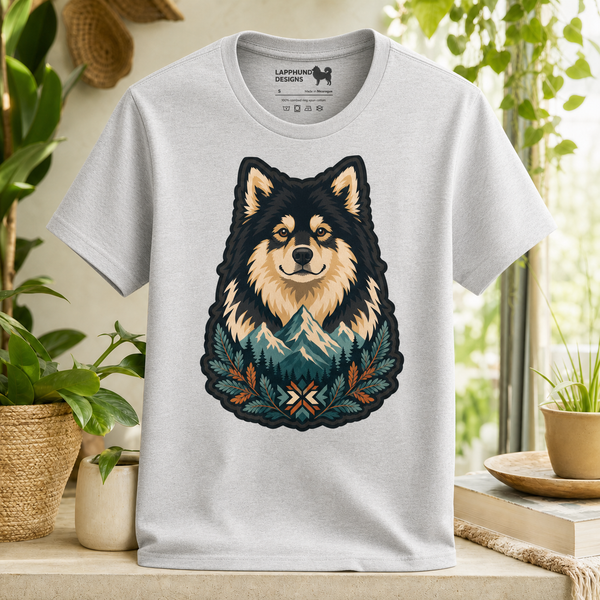
When you do land on your sport, you will meet the rest of us at the crate row, all wearing something with a Lappy on it. There is a sports and athletics sticker sheet that lives on a lot of dog sport tack boxes, and the Finnish Lapphund tees are drawn coat by coat, so the dog on your shirt can be the dog in your crate.
Yes. They are agile, quick to turn and capable of sudden bursts of speed, and they jump in a middle height division because of their size. They rarely beat a Border Collie on raw speed, and they earn clean runs and titles regularly. Expect your dog to bark its way around the course, which judges do not penalise.
Ground-level work can start at eight weeks: tricks, targeting, flatwork, scent games and short tracks. AKC awards trick titles from 4 months, and rally, obedience and scent work start at 6 months. Full-height jumping waits until the growth plates close, generally between 12 and 18 months, and your vet should confirm before you raise the bars.
Many can. The breed was developed to move reindeer with voice and body position, so a Lappy on stock tends to be vocal, upright and close-working. AKC instinct tests accept dogs from 6 months and need no prior training, and the American Herding Breed Association runs an approachable set of tests for rarer breeds.
It is the best first sport for most of them. AKC Scent Work uses birch, anise, clove and cypress oils across four levels and accepts dogs from 6 months, and Canada has the Sporting Detection Dogs Association and CKC scent detection trials. It works indoors through winter, suits shy or senior dogs, and tires a working brain fast.
They often do, because the breed is friendly, calm and gentle with strangers. The AKC awards therapy titles from 10 visits (THDN) up to 600 visits, though your dog must first be certified by an AKC recognised therapy dog organisation. Finland has run its own kaverikoira care dog programme through the Finnish Kennel Club since 2001.
Less than most people expect at the beginning. A six week foundation class at a local club, a flat collar and lead, a mat and good treats will get you going, and scent work needs almost no equipment. Costs climb once you travel to trials, pay entry fees and buy a crate setup, so start local and see whether you both love it.

Written by Jill, co-founder of Lapphund Designs. Jill lives in Castlegar, BC with her husband and their two Finnish Lapphunds, Timber and Tundra.
Every design in the shop starts from the real Finnish Lapphund. See every design Pick your Lappy's coat
The signature Lappy Lean is a well-known breed behavior where they press their entire body against their favorite person.
The doorbell is the whole problem. A Finnish Lapphund spends eleven months of the year learning t...

I have heard our breed called a Lap-a-hound, a Finnish Lap Hound and, once, a Finnish Lampshade. ...

A few times a month somebody sends me a photo of a fluffy dog and asks whether it is part Finnish...
Comments (0)
Leave a comment